
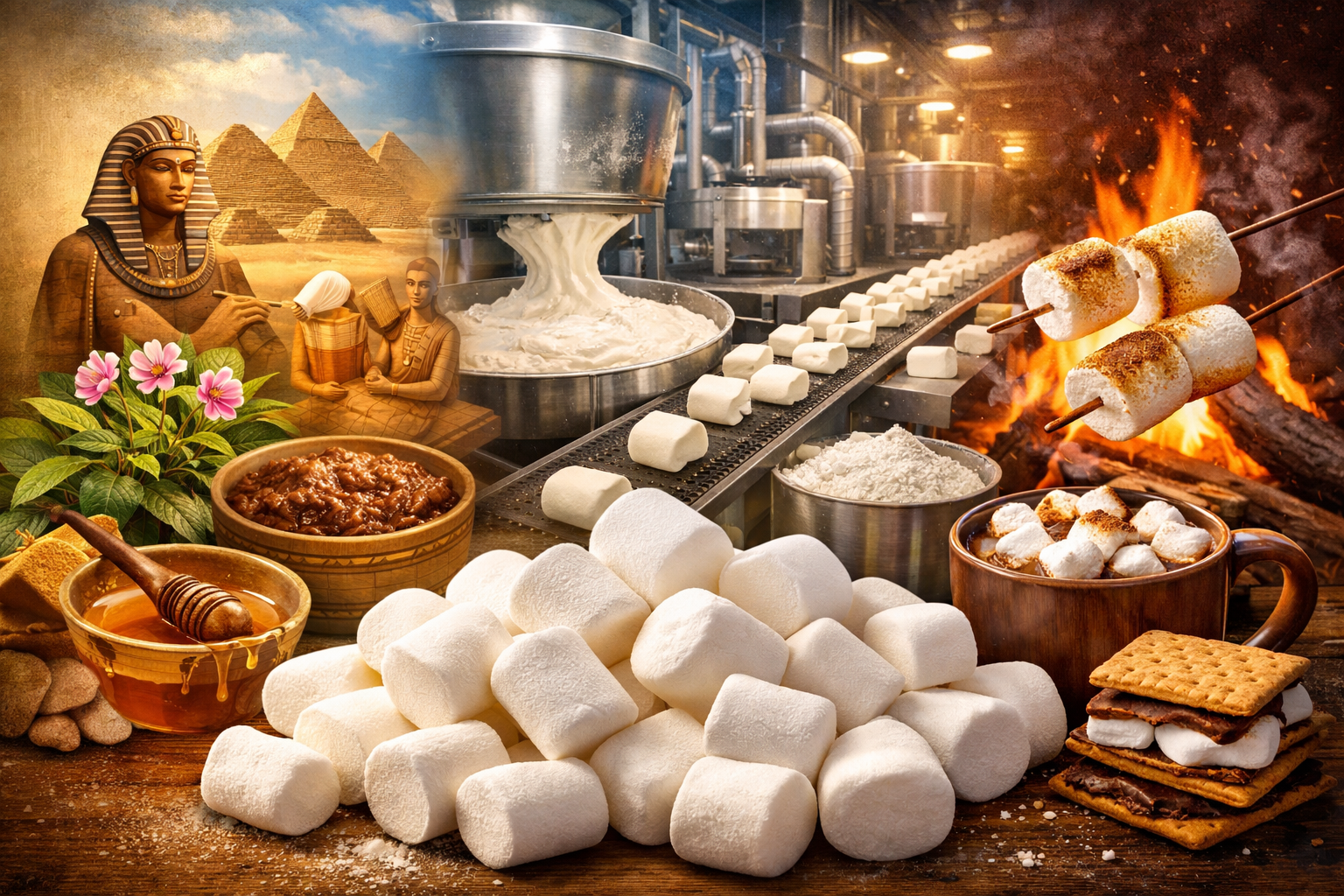
Marshmallows are soft, airy, and deceptively simple. Found floating in hot chocolate, toasted over campfires, and folded into countless desserts, they have quietly become one of the world’s most beloved confections. Yet behind their cloud-like texture lies a surprisingly rich history and a carefully engineered manufacturing process.
In this article, we explore the origin of marshmallows, how marshmallows are manufactured, and how modern production methods transformed an ancient remedy into a global treat.
The Origin of Marshmallows: From Medicinal Plant to Sweet Confection
The story of marshmallows begins thousands of years ago, long before sugar became a pantry staple.
Ancient Egypt and the Marsh Mallow Plant
The earliest marshmallows can be traced back to ancient Egypt around 2000 BCE. Egyptians harvested the root of the marsh mallow plant (Althaea officinalis), which grows in marshy wetlands. The root produces a thick, sticky sap that was extracted and mixed with honey and nuts.
This early version of marshmallow was not a casual snack. It was considered a medicinal confection, used to soothe sore throats, coughs, and digestive discomfort. Only royalty and priests had access to it, making marshmallows an elite indulgence.
Marshmallows in Europe: Medicine Becomes Delicacy
By the 19th century, marshmallow root made its way into European pharmacies, especially in France.
The French “Pâte de Guimauve”
French confectioners refined the process, creating a whipped sweet known as pâte de guimauve. Marshmallow sap was whipped with egg whites and sugar to create a light, spongy texture.
This version moved marshmallows closer to what we recognize today. However, production remained slow and labor-intensive. Extracting sap from marshmallow roots was expensive and inconsistent, limiting large-scale availability.
The Industrial Revolution and the Modern Marshmallow
The true transformation of marshmallows occurred in the late 19th and early 20th centuries.
Replacing Marshmallow Root with Gelatin
Manufacturers discovered that gelatin could replicate the binding and fluffing properties of marshmallow root far more efficiently. This change revolutionized production, making marshmallows cheaper, more stable, and easier to mass-produce.
By the early 1900s, marshmallows had evolved from medicinal treats into a commercial confection.
How Marshmallows Are Made Today
Modern marshmallow manufacturing is a precise blend of food science and industrial engineering. Despite their simplicity, marshmallows require careful control of temperature, aeration, and timing.
Key Ingredients in Marshmallows
Most commercially produced marshmallows contain:
-
Sugar or corn syrup
-
Gelatin
-
Water
-
Air
-
Flavorings and colorings
Each ingredient plays a specific role in texture, elasticity, and shelf stability.
Step-by-Step Marshmallow Manufacturing Process
1. Creating the Sugar Syrup
Sugar and corn syrup are heated with water to form a thick syrup. The temperature is carefully monitored to ensure proper viscosity.
2. Hydrating and Dissolving Gelatin
Gelatin is soaked in warm water until fully dissolved. This creates the structural framework that allows marshmallows to hold their shape.
3. Whipping and Aeration
The syrup and gelatin mixture is whipped at high speed, injecting air into the mixture. This step creates the signature fluffy texture. The more air added, the lighter the marshmallow.
4. Extrusion or Molding
The marshmallow mixture is either extruded into long tubes and cut into shapes or poured into starch molds. Cornstarch or powdered sugar prevents sticking.
5. Setting and Cooling
Marshmallows are allowed to cool and set. As they stabilize, the gelatin firms up while retaining elasticity.
6. Packaging
Once set, marshmallows are dusted, sorted, and packaged for distribution.
Why Marshmallows Are So Soft: The Science Behind the Texture
Marshmallows are a type of aerated foam confection. Their softness comes from millions of tiny air bubbles trapped within a sugar-gelatin matrix. Gelatin acts as a stabilizer, preventing the foam from collapsing.
This structure explains why marshmallows melt when heated and puff up when toasted. Heat weakens the gelatin network while expanding the trapped air.
Marshmallows Today: From Campfires to Culinary Creations
Today, marshmallows are used in everything from s’mores and hot chocolate to gourmet desserts and vegan alternatives made with agar or starches.
The humble marshmallow has traveled an impressive path. It began as a medicinal sap harvested from wetlands and evolved into a globally recognized symbol of comfort, nostalgia, and sweetness.
Final Thoughts
Marshmallows may look simple, but their history and production tell a much richer story. From ancient Egyptian medicine to modern manufacturing lines, wholesale marshmallows are a perfect example of how food evolves alongside technology and culture.
The next time a marshmallow melts into a mug of cocoa or browns over an open flame, it carries with it thousands of years of history and a surprisingly sophisticated manufacturing process. 🍬